Is IPTV legal in 2026? It is one of the most searched questions in the streaming world right now, and it deserves a straight answer without the legal jargon, the vague disclaimers, or the fear-mongering that dominates most articles on the subject.
The short answer is yes, IPTV is legal. The longer answer is that legality depends entirely on the provider you choose and the content they are licensed to distribute. Understanding that distinction takes about five minutes and protects you completely as a subscriber.
This guide gives you the honest, complete picture so you can stream with confidence in 2026 and make informed decisions about every IPTV subscription you consider.
Is IPTV legal in 2026? Yes, IPTV technology itself is completely legal everywhere in the world. The legality of any specific service depends on whether the provider holds proper broadcasting licences for the content they distribute. Licensed IPTV services are fully legal to subscribe to and use. Unlicensed services distributing content without rights are illegal at the provider level, not the subscriber level in most jurisdictions. Always choose a licensed provider and stream with complete peace of mind.
Table of Contents
Understanding What IPTV Actually Is in 2026
Before answering whether IPTV is legal in 2026, it helps to understand precisely what IPTV is and what it is not. Confusion about the technology itself drives most of the legal uncertainty that surrounds it in public conversation.
IPTV stands for Internet Protocol Television. It is simply a method of delivering television content over an internet connection rather than through a traditional broadcast antenna, cable wire, or satellite dish. The technology itself is identical to the infrastructure that Netflix, Disney Plus, YouTube, and Amazon Prime Video use to deliver their content to your screen.
When you watch Netflix, you are using IPTV technology. When you stream a football match on Amazon Prime Video, you are using IPTV technology. The delivery mechanism is the same across all of these services. What differs is the licensing status of the content being delivered and the business model of the provider distributing it.
This distinction is the entire foundation of the IPTV legality question. The technology is neutral. It is the content licensing status of the specific service you subscribe to that determines whether your subscription sits on the right or wrong side of the law. Once you understand this, the question becomes far simpler to answer for any specific provider.
Legal IPTV services hold broadcasting licences for every channel and piece of content they distribute. They pay rights holders, comply with regional broadcasting regulations, and operate within the same legal framework as any other licensed television broadcaster. Subscribing to and using these services is completely legal for viewers in every country where the service operates.
Is IPTV Legal in 2026 When It Comes to Licensed Services
Licensed IPTV services are unambiguously legal in 2026 in every major jurisdiction around the world. This category includes a much wider range of services than most people realise when they first encounter the question.
Every major streaming platform you already use operates as a licensed IPTV service. Netflix, Amazon Prime Video, Disney Plus, Apple TV Plus, HBO Max, Hulu, and Peacock are all IPTV services in the technical sense of the term. They deliver television content over internet protocol. They are legal because they licence every piece of content they distribute.
Beyond the household names, thousands of smaller licensed IPTV providers exist across the world offering live television, sports, and entertainment content with proper broadcasting rights. These providers have negotiated carriage agreements with channel owners, pay licensing fees, and operate transparently as legitimate television distributors.
For subscribers, choosing a licensed provider means zero legal exposure. You are simply a consumer purchasing access to a licensed television service, which is legally identical to subscribing to cable television or a satellite package. Your subscription payment supports rights holders through the provider’s licensing agreements, and the entire transaction sits cleanly within the law.
The simplest indicator of a licensed IPTV service is transparency. Licensed providers display clear terms of service, registered business information, and legitimate payment processing. They do not hide behind anonymous websites or accept only cryptocurrency payments, because they have nothing to hide from a legal standpoint.
You can explore legitimate IPTV subscription plans from transparent providers who operate clearly within the legal framework and offer verifiable service details before you spend anything.
What Makes an IPTV Service Illegal in 2026
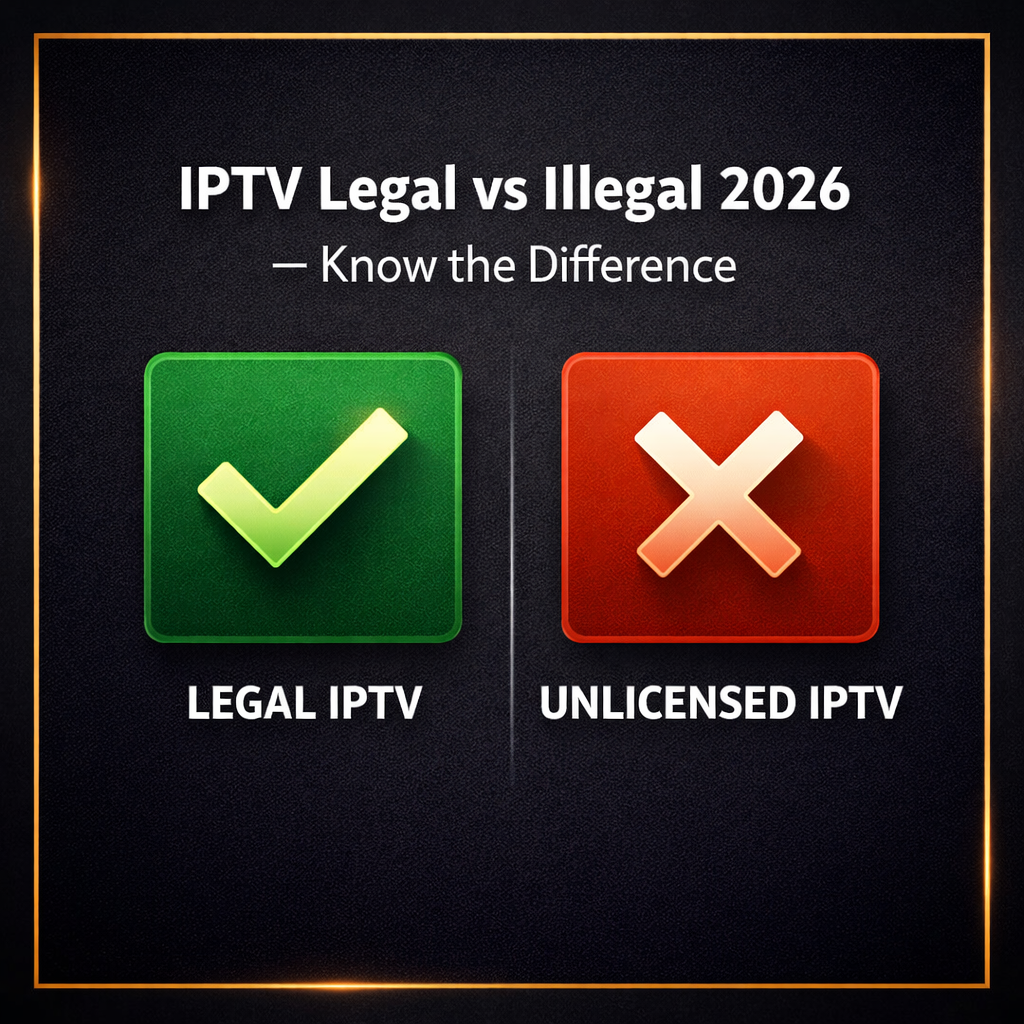
Understanding what makes an IPTV service illegal in 2026 is just as important as understanding what makes one legal. The illegal category is defined by one specific characteristic: distributing content without holding the rights to distribute it.
An unlicensed IPTV provider acquires live channel feeds and VOD content without paying the rights holders who own that content. They then sell subscriptions to that content at prices far below what licensed competitors charge, because their cost base is essentially zero. They pay nothing for the content they sell access to.
This is where the legal issue genuinely lies, and it lies primarily with the provider, not the subscriber. The provider is the party committing the infringing act by distributing content they do not have the rights to distribute. In most legal jurisdictions around the world, including the United States, the United Kingdom, and the European Union, the distribution of unlicensed content is the actionable offence.
Subscriber liability in most jurisdictions is significantly more limited. Most countries do not prosecute individual subscribers for accessing unlicensed streams, treating the enforcement effort as most productively directed at the distribution source. This does not mean subscriber activity is completely without risk in every jurisdiction, but it accurately reflects where enforcement activity actually focuses in practice.
The clearest red flags for an unlicensed service are pricing that seems impossibly low, no visible company registration or business address, payment methods limited to cryptocurrency or untraceable transfers, and channel lists that include premium sports packages for a fraction of what those rights legitimately cost.
IPTV Legal Status by Country in 2026
The legal status of IPTV varies in nuance across different countries, and understanding your specific jurisdiction gives you a clearer picture of your position as a subscriber in 2026.
In the United States, IPTV technology is completely legal. The legal framework around content distribution falls under copyright law, and enforcement has focused almost exclusively on providers and distributors rather than end subscribers. The Department of Justice and major rights holders pursue the operators of unlicensed services rather than their customer base.
In the United Kingdom, the legal framework is similar in that enforcement targets providers and distributors. The Police Intellectual Property Crime Unit focuses its activity on operators of unlicensed IPTV services. Individual subscribers using unlicensed services occupy a legal grey area rather than a clearly criminal one, though the safest and most straightforward position is always to choose a licensed provider.
Across the European Union, a 2017 ruling established that streaming unlicensed content knowingly can constitute infringement at the subscriber level in some member states, which is a more direct consideration than in the US or UK. This makes choosing a licensed provider even more clearly the right decision for European subscribers who want complete peace of mind.
In most other major markets including Canada, Australia, and the Gulf states, enforcement similarly targets distribution rather than consumption, but the legal frameworks continue to evolve and tighten year on year as rights holders invest more resources in protecting their content.
How to Choose a Legal IPTV Service in 2026
Choosing a legal IPTV service in 2026 is straightforward when you know what to look for. The indicators of a legitimate, licensed provider are consistent across the market and easy to verify before you spend anything.
Transparency is the first and most reliable indicator. A legal IPTV provider displays clear company information, registered business details, legitimate contact channels including email and customer support, and terms of service that outline your rights as a subscriber. This level of transparency is only possible for a provider operating legally because unlicensed operators cannot afford the visibility.
Pricing that reflects real licensing costs is the second indicator. Broadcasting rights for major sports and entertainment content cost money. Lots of it. A provider offering access to Sky Sports, ESPN, HBO, and thousands of premium channels for $3 per month is not paying for those rights. A provider charging $10 to $12 per month is operating in a price range consistent with legitimate licensing and infrastructure costs.
Legitimate payment processing through recognised providers like PayPal, Stripe, or major credit card networks indicates a provider comfortable with financial transparency. Payment processors conduct due diligence on the businesses they work with, which creates an additional layer of legitimacy verification beyond the provider’s own claims.
For anyone who wants to test a service before committing financially, the best free IPTV trial from a transparent provider costs nothing and gives you 24 hours to verify stream quality, check the channel lineup, and confirm the service matches its advertised specifications before any payment changes hands.
IPTV Legal in 2026 and the Future of Streaming Rights
The regulatory landscape around IPTV and streaming rights continues to evolve in 2026, and understanding the direction of travel helps subscribers make decisions that remain solid not just today but over the next several years.
Rights holders including major sports leagues, Hollywood studios, and broadcast networks have become significantly more sophisticated in their approach to IPTV enforcement over the past three years. Automated monitoring systems now scan the internet continuously for unlicensed streams of premium content, identifying providers and triggering rapid takedown processes that were far slower and less effective as recently as 2022.
This enforcement sophistication means that unlicensed IPTV providers face increasingly short operational lifespans. Services that appear promising shut down without warning, leaving subscribers with a paid subscription and no service. This operational risk is entirely absent when you subscribe to a licensed provider, whose business model depends on continued legal operation and long-term subscriber retention.
The legitimate IPTV market is growing rapidly in response to the same cord-cutting trends that drove the growth of unlicensed services. More licensed options at competitive price points now exist than at any previous point, which removes the pricing justification that once made unlicensed services the only budget-friendly option for many subscribers.
For a comprehensive understanding of how IPTV technology works and why the delivery method itself carries no legal concern, this detailed explanation of what Xtream Codes is and how IPTV works covers the technical foundation in plain language without jargon.
Frequently Asked Questions
Is IPTV legal in 2026?
Yes, IPTV technology is completely legal in 2026 everywhere in the world. The legality of any specific service depends entirely on whether the provider holds proper licences for the content they distribute. Subscribing to a licensed IPTV provider is legally identical to subscribing to cable television or any other licensed broadcast service.
Can I get in trouble for using IPTV in 2026?
Using a licensed IPTV service carries zero legal risk. Using an unlicensed service puts you in a legal grey area that varies by country, though enforcement in most major jurisdictions focuses on providers and distributors rather than individual subscribers. The safest, most straightforward position is always to choose a transparent, licensed provider.
How do I know if an IPTV service is legal?
Look for transparent company information, legitimate payment processing through recognised providers, pricing consistent with real licensing costs, clear terms of service, and responsive customer support. Legal providers have nothing to hide and display all of these indicators openly. Suspiciously low pricing and anonymous payment methods are the clearest warning signs of an unlicensed service.
Is watching IPTV on Firestick legal in 2026?
Using a Firestick to access a licensed IPTV service is completely legal. The Firestick is simply a device for accessing internet-delivered content, and using it with a legitimate IPTV subscription is no different legally from using it to watch Netflix or Amazon Prime Video. The device itself carries no legal concern whatsoever.
What is the difference between legal and illegal IPTV?
Legal IPTV services hold broadcasting licences for every channel and piece of content they distribute and pay rights holders accordingly. Illegal IPTV services distribute content without holding the necessary licences or paying rights holders. The distinction is entirely about content licensing at the provider level, not about the technology or the viewer.
Stream Legally and Confidently in 2026
Is IPTV legal in 2026? Absolutely yes, when you choose the right provider. The technology is legal, the delivery method is legal, and subscribing to a licensed IPTV service is as legally clean as any other television subscription you have ever paid for.
The providers ranked throughout this site operate transparently, price their services in line with real licensing costs, and give you a free trial before asking for any payment. That combination of transparency, fair pricing, and testability before commitment is the hallmark of a legal IPTV service operating with complete confidence in 2026. Choose wisely, stream freely, and never pay a cable bill you resent again.