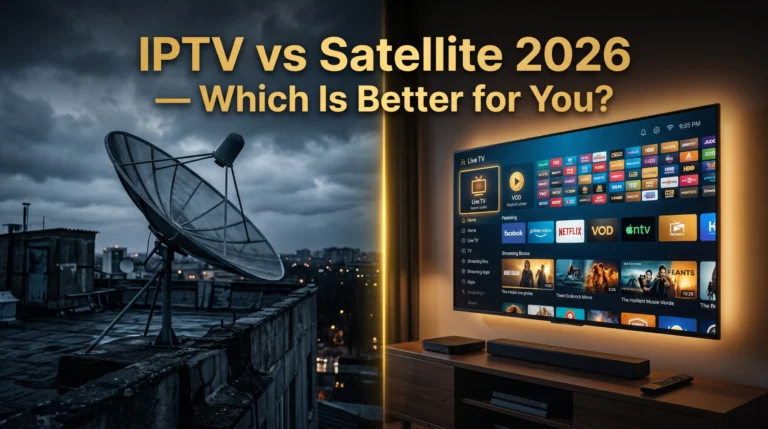
IPTV vs satellite 2026 is the comparison that every household still paying for a satellite subscription needs to see before renewing their contract for another year. Satellite television has been the premium content delivery standard for decades, and for much of that time the argument for keeping it was compelling. High channel counts, reliable signal, 24-hour availability, and the sports and entertainment packages that viewers could not get anywhere else.
In 2026 that argument has collapsed. Every advantage that satellite once held over internet-delivered television has either disappeared or reversed. IPTV in 2026 delivers more channels, better picture quality in many scenarios, complete device flexibility, global access from anywhere, and a monthly cost that is between 80% and 90% lower than a comparable satellite package from Sky, DirecTV, or any other major provider.
This is not a guide designed to dismiss satellite unfairly. It is an honest category-by-category comparison using real numbers and real performance data that lets the evidence speak rather than the conclusion. If satellite still wins in any category that matters specifically to your household, this guide will tell you that directly.
In the IPTV vs satellite 2026 comparison, IPTV wins on price by 80% to 90%, wins on channel count by a factor of 30 to 50 times, wins on device flexibility giving access on any screen anywhere in the world, wins on contract freedom with no lock-in periods, and wins on 4K HDR picture quality through higher bitrate delivery. Satellite wins on signal reliability independent of internet connection and on accessibility for households in areas with very slow or no broadband internet. For the vast majority of households with standard broadband in 2026, IPTV is the superior choice on every metric that affects daily viewing satisfaction.
Table of Contents
IPTV vs Satellite 2026: Price Comparison
The price comparison between IPTV and satellite in 2026 is the most immediately striking difference between the two delivery methods and the one that provokes the most disbelief from subscribers who have been paying satellite prices for years without questioning whether an alternative existed.
Sky TV in the United Kingdom charges between £75 and £110 per month for a complete entertainment and sports package. DirecTV in the United States charges between $85 and $155 per month for comparable packages depending on tier selection. Foxtel in Australia charges between $49 and $99 AUD per month. Canal Plus in France charges between €45 and €90 per month. Every major satellite provider in every major market in 2026 charges prices that have increased year on year for the past decade without corresponding improvements in the quality or breadth of content that justify the increases.
A premium IPTV subscription in 2026 costs $12 per month on rolling monthly billing. On an annual plan the effective monthly cost drops to $5 per month. There is no equipment rental fee. There is no installation charge. There is no contract termination penalty. There is no annual price increase built into the billing structure. The price you pay in January 2026 is the price you pay in December 2026 unless you choose to change your plan yourself.
The annual saving from switching from Sky TV to a premium IPTV subscription for a British household is between £780 and £1,200 per year. The saving from switching from DirecTV to IPTV for an American household is between $876 and $1,716 per year. These are not marginal differences that require careful cost-benefit analysis. They are transformational savings that fundamentally change household discretionary budgets.
The equipment cost comparison adds another layer to the financial case against satellite. Satellite requires a dish installation that may cost between $50 and $200 in installation fees depending on the provider and the property. It requires a set-top box or satellite receiver that is either rented for $8 to $15 per month or purchased outright. IPTV requires only an internet connection that most households already have and a streaming device that most households already own. The marginal hardware cost of adding IPTV to an existing household setup is in most cases zero.
IPTV vs Satellite 2026: Channel Count and Variety
The channel count comparison between IPTV and satellite in 2026 is so one-sided that it barely qualifies as a comparison. A comprehensive Sky or DirecTV satellite package delivers between 300 and 500 channels depending on the tier. A premium IPTV subscription delivers between 10,000 and 16,000 channels. The ratio is 30 to 50 times more channels from IPTV at 80% to 90% less cost.
The more meaningful comparison within those numbers is the quality and relevance of what each delivery method includes within its channel count. Satellite packages in 2026 pad their channel counts with shopping channels, infomercial networks, and local access channels that the vast majority of subscribers never consciously choose to watch. The genuinely watched channel count within a satellite package for most households is between 10 and 20 regularly accessed channels out of 300 to 500 available.
IPTV’s 16,000 channel library includes every channel that a satellite package carries, plus thousands of international channels that satellite packages either exclude entirely or lock behind expensive international add-on packages. Arabic channels, South Asian channels, Latin American channels, Eastern European channels, African channels, and content from dozens of other markets are all included within a standard IPTV subscription at no additional cost.
Sports channel depth is the category where satellite once held a genuine content advantage through exclusive rights deals that prevented content from appearing anywhere else. In 2026 quality IPTV providers carry every major sports channel from every major rights holder simultaneously, which means the exclusive rights argument for satellite no longer applies to IPTV subscribers who access the same content through different delivery infrastructure.
VOD library depth is another category where IPTV dramatically outperforms satellite. Most satellite VOD libraries contain a few thousand titles with additional per-title charges for new releases. A quality IPTV subscription includes a VOD library of 50,000 to 60,000 titles with no per-title charges and regular additions of new releases within 48 to 72 hours of their digital distribution date.
IPTV vs Satellite 2026: Picture Quality
Picture quality has historically been the strongest technical argument for satellite television, and for the majority of satellite broadcasting history from the 1990s through the 2010s, satellite delivered superior picture quality to cable and internet alternatives. In 2026 that advantage has not just narrowed but reversed at the top quality tier.
Standard satellite broadcasts are compressed to fit within the finite bandwidth of satellite transponder capacity. A satellite transponder carries dozens of channels simultaneously and allocates bandwidth across all of them, which means each channel receives a fraction of the total available bandwidth rather than the dedicated bandwidth that a quality IPTV CDN delivers to each stream. The practical result is that satellite HD broadcasts in 2026 typically carry bitrates between 5 and 12 Mbps per channel, which delivers acceptable HD quality but falls short of the visual fidelity that high-bitrate streaming achieves.
Quality IPTV providers in 2026 deliver HD streams at 10 to 20 Mbps per channel and 4K streams at 25 to 35 Mbps. These bitrates exceed what satellite can deliver within its bandwidth constraints and produce visibly superior picture quality on large screens above 55 inches where compression artifacts from lower-bitrate broadcasts become visible to the naked eye during fast-moving content like football matches or motorsport.
Satellite 4K is available from providers including Sky and DirecTV in limited form, but the 4K content they carry uses more aggressive compression than IPTV 4K delivers because transponder bandwidth constraints apply equally to 4K content as to HD. IPTV 4K HDR at full 35 Mbps bitrate represents a genuinely superior viewing experience to satellite 4K on any display capable of showing the quality difference, which includes most modern OLED and QLED televisions in the upper size ranges.
Weather dependence is the picture quality reliability factor that satellite cannot overcome regardless of compression improvements. Heavy rain, thick cloud cover, and snowfall all degrade or completely interrupt satellite signal quality because the broadcast frequency is physically affected by atmospheric moisture. IPTV delivers consistent picture quality in any weather because the signal travels through underground fibre and copper infrastructure rather than through the atmosphere.
| Category | IPTV 2026 | Satellite 2026 | Winner |
|---|---|---|---|
| Monthly price | $10 to $12 | $85 to $155 | IPTV |
| Channel count | 10,000 to 16,000 | 300 to 500 | IPTV |
| 4K HDR quality | Native 4K up to 35 Mbps | Compressed 4K 8 to 15 Mbps | IPTV |
| Weather reliability | Unaffected by weather | Disrupted by heavy rain or snow | IPTV |
| Device flexibility | Every device anywhere | Set-top box in one location | IPTV |
| Global access | Works from any country | Fixed footprint only | IPTV |
| Contract requirement | No contract | 12 to 24 months | IPTV |
| VOD library | 50,000 to 60,000 titles | Limited, per-title fees | IPTV |
| Internet independence | Requires broadband | Works without internet | Satellite |
| Rural availability | Requires 10 Mbps minimum | Available anywhere with sky view | Satellite |
IPTV vs Satellite 2026: Device Flexibility and Accessibility
Device flexibility is the category where the lifestyle difference between IPTV and satellite is most practically felt in daily household use. Satellite television is physically anchored to the location where the dish is installed and the set-top box is connected. Every television in the household that you want to receive satellite content requires either a separate satellite card, a distribution amplifier, or a satellite receiver, all of which cost additional money and create additional hardware complexity.
IPTV works on every screen you already own simultaneously from a single subscription. The same credentials that load your channels on your Firestick in the living room load them on your phone in the kitchen, on your tablet in the bedroom, on your Smart TV in the spare room, and on your laptop wherever you happen to be in the house or in the world. No additional hardware, no cable runs between rooms, and no additional monthly charges per device regardless of how many screens access the service simultaneously within your connection count.
The travel freedom that IPTV provides is genuinely transformative for households where members travel regularly. A satellite subscription stops at the property boundary. An IPTV subscription travels in your phone and loads on the hotel television via the HDMI port from your laptop, giving you access to every channel you watch at home from any hotel, holiday rental, or office in any country with a WiFi connection.
Expat communities worldwide have discovered this IPTV travel freedom most dramatically. British expats watching BBC One from Spain, Canadian expats watching Hockey Night in Canada from London, and Arabic expats watching MBC drama from Sydney all experience a connection to home country television that satellite technology made impossible for most expat households due to dish footprint limitations and installation restrictions.
IPTV vs Satellite 2026: Reliability and Uptime
Reliability comparison between IPTV and satellite in 2026 requires separating two distinct dimensions. Physical signal delivery reliability where satellite traditionally excels, and server infrastructure reliability where modern IPTV has achieved parity or superiority with premium satellite providers.
Satellite signal reliability is genuinely excellent in clear weather conditions and for the most part in moderate weather. The signal travels directly from the satellite to your dish at the speed of light through the atmosphere without any intermediate routing infrastructure that can fail. This gives satellite a form of technical elegance in its delivery path that IPTV’s multi-hop internet routing cannot replicate.
The weakness in satellite reliability is weather dependence. Heavy rain causes signal attenuation that reduces picture quality or eliminates signal entirely. Snow accumulation on a dish interrupts service until the dish is cleared. Heavy cloud cover during storms can cause temporary signal loss. These weather-related outages are predictable in certain climates and genuinely frustrating during the winter sports season when the worst weather coincides with the most-watched broadcasting calendar.
IPTV reliability from top providers in 2026 has reached 99.9% uptime across properly maintained server infrastructure, which translates to approximately 8 hours of downtime per year. This level of reliability is comparable to satellite service uptime in temperate climates and superior to satellite reliability in climates with frequent heavy precipitation. The IPTV outage is most likely to occur during planned maintenance windows that can be scheduled at low-traffic hours, while satellite outages are determined by weather patterns that do not accommodate viewer preferences.
For households in rural areas where broadband internet either does not reach or delivers speeds below the 10 Mbps minimum required for HD IPTV streaming, satellite remains the more reliable option for television content delivery until broadband infrastructure reaches their location. This is the only use case in 2026 where satellite holds a clear practical advantage over IPTV that cannot be overcome by any configuration or optimisation on the IPTV side.
For a free trial to test whether your specific internet connection delivers adequate IPTV performance before making any satellite cancellation decision, this free 24-hour IPTV trial requires no credit card and gives you a definitive answer about your connection’s capability within 24 hours of activation.
When Satellite Still Makes Sense in 2026
Honest comparison requires acknowledging the specific circumstances where satellite television remains the better choice for specific households in 2026, rather than presenting IPTV as a universal replacement without qualification.
Rural households without adequate broadband coverage are the clearest case where satellite retains a practical advantage that IPTV cannot overcome. If your internet connection delivers consistently below 10 Mbps with high jitter and frequent outages, IPTV will not provide a reliable daily television experience regardless of which provider you choose. Satellite delivers consistent signal quality in rural locations where broadband infrastructure investment has not reached, which makes it the only viable option for quality television delivery in these specific circumstances.
Households where multiple residents have strong personal resistance to technology changes may find the satellite set-top box’s familiar interface easier to maintain without regular technical intervention. IPTV requires initial setup effort, periodic app updates, and occasional troubleshooting that not every household has a member comfortable managing. For households where the primary television viewer is not technically confident and has no support available, satellite’s self-contained simplicity has genuine value that goes beyond the technical comparison.
Specific circumstances where satellite provides unique access include remote locations beyond cellular coverage, boats and caravans with mobile satellite dishes, and international travelers with portable satellite equipment. These niche applications have no IPTV equivalent because they depend on satellite’s fundamental physical independence from ground-based network infrastructure.
Frequently Asked Questions
Is IPTV better than satellite in 2026?
For the vast majority of households with standard broadband internet above 10 Mbps, IPTV is better than satellite in 2026 across every practical category. It costs 80% to 90% less per month, delivers 30 to 50 times more channels, provides superior 4K HDR picture quality through higher bitrate delivery, works on every device anywhere in the world, requires no contracts, and is unaffected by weather. Satellite retains an advantage only for rural households without adequate broadband and for specific mobile applications.
Can IPTV replace satellite TV in 2026?
Yes, IPTV can fully replace satellite television for any household with a stable internet connection above 10 Mbps. Every channel that a satellite package carries is available through quality IPTV subscriptions alongside thousands of additional international channels that satellite packages do not include. The replacement involves cancelling your satellite contract, potentially paying a termination fee depending on your remaining contract period, and switching to a monthly IPTV subscription at a fraction of the satellite cost.
Does IPTV work better than satellite in bad weather?
Yes, IPTV is completely unaffected by weather because the signal travels through underground internet infrastructure rather than through the atmosphere. Heavy rain, snow, storms, and thick cloud cover all affect satellite signal quality and can interrupt service entirely during severe weather. IPTV delivers the same consistent picture quality during a blizzard as on a clear summer day, which eliminates the most frustrating aspect of satellite television for households in climates with frequent poor weather.
How much do I save switching from satellite to IPTV in 2026?
The saving from switching from satellite to IPTV in 2026 varies by your current satellite package but typically ranges from $75 to $140 per month for American DirecTV or Dish subscribers and £65 to £100 per month for British Sky TV subscribers. Over a full year this represents a saving of between $900 and $1,680 in the US and between £780 and £1,200 in the UK, assuming you choose a comparable IPTV subscription that delivers the same content coverage.
What internet speed do I need to replace satellite with IPTV in 2026?
You need a minimum of 10 Mbps dedicated to a single HD IPTV stream to replace satellite with IPTV. For 4K content you need 25 Mbps or above. For a household with multiple simultaneous viewers replacing a satellite service that served multiple televisions, you need 50 Mbps or above to ensure every screen receives stable HD quality without bandwidth competition. Run a speed test on your streaming device during your normal viewing hours to confirm your connection meets these requirements before cancelling your satellite subscription.
The Verdict on IPTV vs Satellite in 2026
The IPTV vs satellite 2026 comparison produces a clear winner for the overwhelming majority of households. IPTV wins on price by a factor of 8 to 12 times. It wins on channel count by a factor of 30 to 50 times. It wins on device flexibility by removing the physical anchor that ties satellite to a single location. It wins on 4K picture quality through higher bitrate delivery. It wins on contract freedom through the absence of any commitment beyond a monthly payment. It wins on weather reliability through signal independence from atmospheric conditions.
Satellite wins on internet independence for rural households and mobile applications where broadband infrastructure does not exist. For urban and suburban households with standard broadband connections above 20 Mbps, which represents the vast majority of television households in developed markets in 2026, that satellite advantage is irrelevant because the broadband requirement is already met by their existing internet subscription.
Test IPTV free for 24 hours on your current internet connection today and make the most informed satellite replacement decision your household has ever made.