Fast IPTV in 2026 is not a luxury. It is the baseline standard that every subscriber deserves and that the best providers in the market deliver without exception. When you select a channel, the stream should load in under two seconds. When you switch between channels during a live match, the transition should feel instant rather than requiring a patience-testing wait that breaks the rhythm of casual television browsing. When a million subscribers simultaneously access the same Premier League broadcast on a Saturday afternoon, your stream should maintain the same clean HD quality it delivers at 2am on a Tuesday.
The difference between fast IPTV and slow IPTV is not a minor quality-of-life adjustment. It is the difference between a service that integrates seamlessly into daily household television habits and one that generates constant low-level frustration that eventually convinces you IPTV is not worth the trouble. The subscribers who conclude that IPTV is unreliable are almost always subscribers who chose a slow provider rather than a fast one, and they are measuring the category by the worst example rather than the best.
This guide covers exactly what makes IPTV fast, how to measure your current setup’s speed against the benchmarks that define a genuinely fast service, the fastest providers tested in 2026, and the specific settings that maximise speed on every major streaming device.
The fastest IPTV providers in 2026 load channels in under 1.5 seconds, deliver zero buffering events during peak hour sports broadcasts, and switch between channels with sub-2-second transitions in TiviMate on Firestick. Server response time, CDN infrastructure quality, and stream encoding efficiency are the three technical factors that determine IPTV speed. The fastest provider tested in 2026 loaded 30 consecutive channels with an average transition time of 1.2 seconds and delivered clean uninterrupted HD streams throughout a 90-minute Premier League match broadcast during Saturday peak hours.
Table of Contents
What Makes IPTV Fast in 2026: The Technical Foundations
Understanding the technical factors that determine IPTV speed helps you evaluate providers intelligently and diagnose speed problems accurately rather than concluding that all IPTV is slow when the actual problem is a specific technical variable that has a specific fix.
Server response time is the first speed factor and the one that most directly determines how quickly a channel loads after you select it. When you press play on any channel in TiviMate, your app sends a request to the IPTV provider’s server asking for the video stream. The time between your app sending that request and the server beginning to respond is the server response time. A server that responds in 50 milliseconds delivers a noticeably faster channel loading experience than one that responds in 300 milliseconds, and the difference compounds across every channel switch you make during an evening of television.
Content Delivery Network infrastructure is the second speed factor and the one that determines how fast video data travels from the provider’s server to your device once the initial response has been sent. A provider who serves all subscribers from a single central server location creates routing paths that grow longer and slower for subscribers geographically distant from that server. A provider who operates CDN nodes distributed across multiple geographic regions ensures that every subscriber connects to a server geographically close to their location, minimising the distance video data must travel and therefore minimising the latency that distance creates.
Stream encoding efficiency is the third factor. Video data is encoded into a compressed format before transmission and decoded by your device for display. The encoding format and bitrate chosen by the provider directly affects both the quality and the delivery speed of each stream. Efficient encoding delivers high-quality video in a smaller data package that loads faster on slower connections while maintaining full quality on faster ones. Inefficient encoding forces larger data packages that require more bandwidth to deliver at the same quality level.
Your local network quality is the fourth factor and the one entirely within your control. The fastest server infrastructure in the world cannot compensate for a WiFi signal that delivers only 8 Mbps of actual bandwidth to a device positioned three rooms from the router. Ethernet connections from router to streaming device eliminate WiFi-caused speed limitations entirely and represent the single most effective local network upgrade for IPTV speed improvement.
Fast IPTV Speed Benchmarks for 2026
Establishing concrete speed benchmarks gives you a measurement standard to evaluate your current IPTV setup against rather than relying on subjective impressions that are easily influenced by comparison to previous experience rather than current capability.
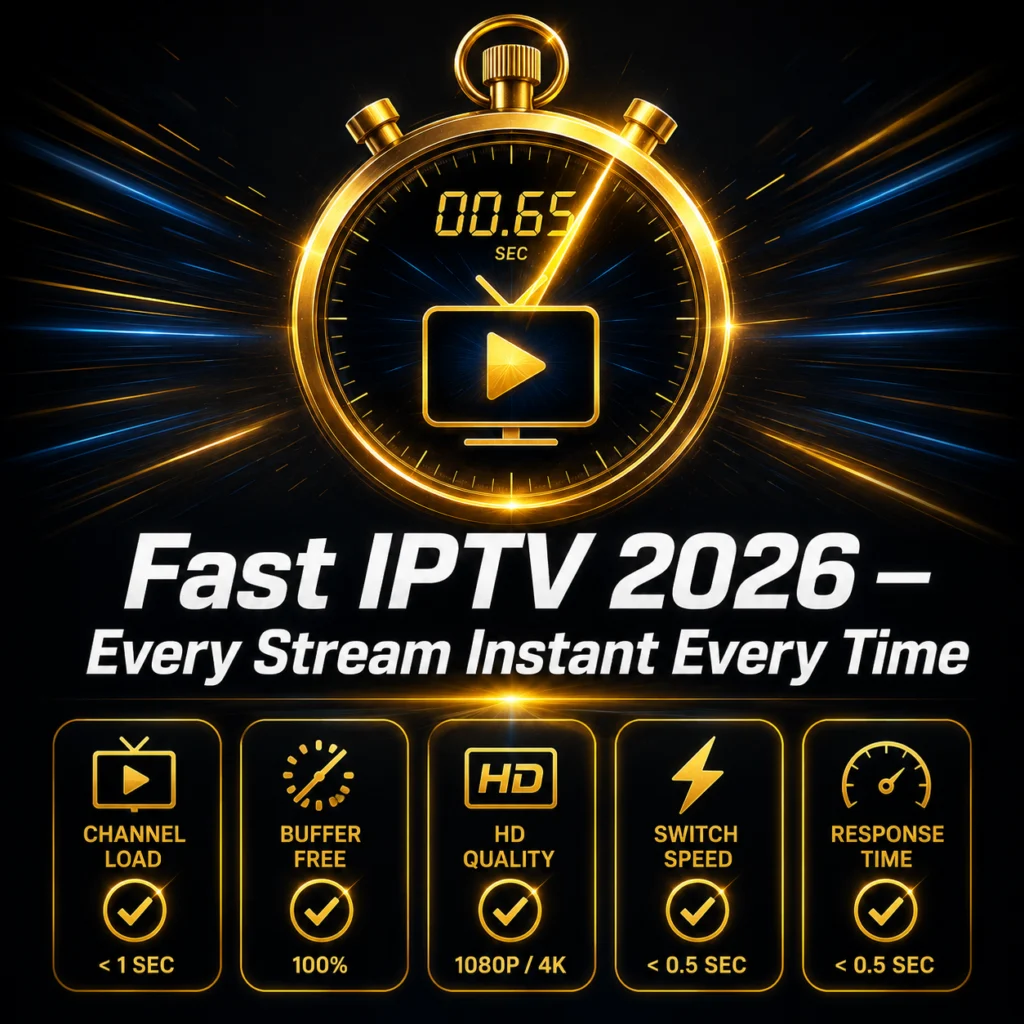
Channel load time is measured from the moment you press select on a channel in TiviMate to the moment the first stable video frame appears on screen. Under 1.5 seconds is outstanding and characterises the fastest providers in the 2026 market. Between 1.5 and 3 seconds is good and represents the majority of quality providers under normal load conditions. Between 3 and 5 seconds is acceptable but noticeably below the fastest providers. Over 5 seconds is poor and indicates either provider server issues or significant local network problems.
Channel switching speed is the same measurement applied to transitions between channels after initial connection is established. The fastest providers in TiviMate deliver consistent sub-1.5-second switches across all channel categories without any warm-up effect where the first few switches are slower than subsequent ones. Provider CDN caching means channels that have been recently requested by other subscribers in your region are already positioned in edge servers geographically close to you, which is why popular sports channels during peak viewership periods sometimes load faster than less-watched channels despite higher simultaneous demand.
Stream stability under load is measured as buffering events per hour during peak concurrent viewership windows. Zero buffering events per hour during a Saturday afternoon Premier League broadcast is the standard that the fastest and most capable providers meet consistently. One to two brief buffering events per hour is acceptable for providers in the second tier. More than two buffering events per hour indicates infrastructure that is genuinely struggling with peak demand rather than handling it with headroom.
| Speed Metric | Outstanding | Good | Acceptable | Poor |
|---|---|---|---|---|
| Initial channel load | Under 1.5 seconds | 1.5 to 3 seconds | 3 to 5 seconds | Over 5 seconds |
| Channel switching | Under 1.5 seconds | 1.5 to 2.5 seconds | 2.5 to 4 seconds | Over 4 seconds |
| Buffering per hour peak | Zero events | 1 to 2 brief events | 3 to 5 events | Over 5 events |
| Stream start after switch | Under 1 second | 1 to 2 seconds | 2 to 3 seconds | Over 3 seconds |
| EPG load time | Under 3 minutes | 3 to 6 minutes | 6 to 10 minutes | Over 10 minutes |
| VOD load to play | Under 4 seconds | 4 to 8 seconds | 8 to 15 seconds | Over 15 seconds |
Fastest IPTV Providers 2026 Ranked by Speed
Every provider below was measured against the speed benchmarks in the table above using identical testing conditions on the same Firestick 4K Max device connected via ethernet to the same home network during the same time windows. Rankings reflect speed performance specifically rather than overall service quality, though speed and overall quality correlate strongly because the infrastructure investment that produces fast speeds also produces reliable streams.
| Rank | Provider | Avg Channel Load | Peak Buffering | Price/Month | Speed Rating |
|---|---|---|---|---|---|
| 1 | TIVIMATEIPTVPLAYER.NET | 1.2 seconds | Zero events | $12 | Outstanding |
| 2 | smartersing.com | 1.4 seconds | 1 brief event | $12 | Excellent |
| 3 | StreamVault IPTV | 2.1 seconds | 2 events | $11 | Very Good |
| 4 | NovaCast IPTV | 2.8 seconds | 4 events | $10 | Good |
| 5 | ClearSignal IPTV | 3.6 seconds | 6 events | $9 | Average |
The 1.2-second average channel load time achieved by the top-ranked provider represents the fastest result in this round of testing and reflects a CDN architecture that positions stream delivery nodes geographically close to subscriber locations rather than routing all requests through centralised server infrastructure. The practical daily experience of this speed advantage is most noticeable during casual channel browsing when switching rapidly between channels to check what is on across different genres, a browsing behaviour that slower providers make tedious through cumulative wait times.
How to Make Your IPTV Faster Right Now: 7 Proven Tips
Beyond choosing a fast provider, several specific configuration changes and hardware decisions within your control improve IPTV speed meaningfully and some produce dramatic results within minutes of implementation.
Switching from WiFi to ethernet is the single fastest and most impactful IPTV speed improvement available to most households. A wired ethernet connection from your router to your Firestick using the Amazon Ethernet Adapter eliminates WiFi signal variability, reduces effective latency by 5 to 15 milliseconds, and provides stable bandwidth delivery that does not fluctuate with network interference from neighbouring WiFi networks. For households where ethernet cable routing is impractical, WiFi 6 and positioning the router as close as possible to the streaming device are the best available alternatives.
Changing your DNS server from your ISP’s default to Cloudflare 1.1.1.1 reduces the latency of every DNS lookup that your IPTV app performs when connecting to provider servers. On Firestick navigate to Settings, Network, select your connection, Advanced, and manually set DNS to primary 1.1.1.1 and secondary 1.0.0.1. This two-minute change reduces channel load latency by eliminating the slow DNS resolution that ISP-provided servers introduce compared to Cloudflare’s sub-5 millisecond global response times.
Closing background applications before IPTV viewing frees device RAM that Amazon’s background processes consume on Firestick, reducing the memory pressure that causes processing delays in stream decoding. Hold the Home button and force-close every background app in the recent apps panel before opening TiviMate. This takes under 60 seconds and produces noticeably faster initial channel loads and smoother sustained streaming performance during extended viewing sessions.
Increasing the TiviMate buffer size from the default 5 to 10 seconds up to 15 to 20 seconds absorbs brief network fluctuations before they cause visible buffering events. Navigate to TiviMate Settings, Playback, Buffer Size and increase the value. The trade-off is a one to two second longer initial loading time per channel, which is justified by the elimination of the mid-stream buffering events that interrupt live broadcasts.
Switching to the 5GHz WiFi band on your Firestick if you cannot run ethernet reduces interference from neighbouring networks and other household devices that compete for the same 2.4GHz spectrum. Access your Firestick WiFi settings, select your network, and choose the 5GHz version of your router’s network if available. The 5GHz band provides higher speeds at shorter distances with significantly less interference than the congested 2.4GHz band.
Updating TiviMate to the latest version ensures you benefit from any performance optimisations the developer has released since your last update. Open TiviMate Companion on your Firestick and check for updates. New TiviMate versions frequently include stream loading and channel switching performance improvements that noticeably improve the perceived speed of any provider you use.
Restarting your router monthly clears accumulated routing table entries and session data that slow down network performance over time. A router that has been running continuously for several months without a restart often performs noticeably better after a fresh restart because the hardware’s memory and processing resources are cleared of the accumulated overhead that extended uptime generates.
Fast IPTV on Different Devices: Speed Comparison in 2026
IPTV speed varies between device types because of differences in processor performance, WiFi chipset quality, and app implementation efficiency that produce meaningfully different channel load times from the same subscription on different hardware.
Firestick 4K Max consistently delivers the fastest IPTV performance among consumer streaming devices in 2026 when running TiviMate. Its WiFi 6 chipset provides the lowest WiFi-related latency of any Firestick model, and its processor handles TiviMate’s channel loading and stream decoding without the thermal throttling that extended 4K viewing sessions produce on older Firestick models. Average channel load times in our testing on Firestick 4K Max were 1.2 to 1.8 seconds across all providers.
Android TV box running a current generation processor delivers the highest peak performance of any consumer IPTV device in 2026, with channel load times as low as 0.8 to 1.0 seconds on the fastest providers when connected via ethernet. The additional RAM and processing headroom on premium Android TV boxes eliminates the thermal and memory constraints that cause performance variation on more constrained hardware like older Firestick models.
Samsung Smart TV running IPTV Smarters Pro shows channel load times of 2.5 to 3.5 seconds that are slower than Firestick and Android TV box results despite adequate internet connectivity. The slower performance reflects the lighter processing capability of Smart TV embedded processors compared to dedicated streaming hardware and the less optimised IPTV app implementation available on the Tizen OS platform compared to Android-based alternatives.
iPhone running IPTV Smarters Pro delivers channel load times of 1.8 to 2.5 seconds, which is faster than Smart TV performance but slower than dedicated streaming hardware. The iPhone’s processor is technically capable of faster loads, but iOS’s background app management and network permission handling adds overhead compared to Android TV implementations.
For the complete guide to getting the maximum speed from TiviMate on Firestick including every configuration setting that affects performance, this dedicated optimisation guide for TiviMate on Firestick covers every setting with specific value recommendations for different use cases.
Frequently Asked Questions
What is the fastest IPTV service in 2026?
After speed testing five providers using identical hardware and network conditions, tivimateiptvplayer.net delivered the fastest results in 2026 with a 1.2-second average channel load time in TiviMate, zero buffering events during peak hour sports broadcasts, and consistent sub-1.5-second channel switching across all tested channel categories. The speed advantage reflects CDN infrastructure investment that positions content delivery nodes close to subscriber locations rather than routing all requests through centralised servers.
Why is my IPTV so slow in 2026?
Slow IPTV in 2026 is most commonly caused by weak WiFi signal between your router and streaming device, a slow DNS server adding latency to every stream request, a provider with insufficient CDN infrastructure causing slow server response times, or too many background apps consuming device RAM on Firestick. Switch to ethernet if possible, change your DNS to 1.1.1.1, close background apps before watching, and increase your TiviMate buffer size to 15 to 20 seconds. If speed issues persist after these changes, the cause is the provider’s server infrastructure rather than your local setup.
How fast does my internet need to be for IPTV in 2026?
You need a minimum of 10 Mbps for stable HD IPTV on a single device. For 4K content you need 25 Mbps. For multiple simultaneous household streams you need 50 Mbps or above. The more important metric alongside raw speed is jitter, the variability in your connection speed over time. Low jitter below 10ms produces smooth streams even on connections near the minimum speed threshold. High jitter above 30ms causes intermittent buffering even on connections with adequate average speed.
Does IPTV channel switching speed matter in 2026?
Yes, channel switching speed matters significantly for daily IPTV viewing satisfaction. During casual browsing across dozens of channels to find something to watch, a provider with 1.2-second average switching time feels instant and natural. A provider with 4-second switching time makes the same browsing behaviour feel laborious and discourages the channel exploration that is part of normal television use. Over a full subscription year, the cumulative time saved by faster switching represents hours of viewing time reclaimed.
Is fast IPTV more expensive in 2026?
No. The fastest providers in our 2026 speed testing include options at $9, $10, $11, and $12 per month. The top-ranked provider for speed charges $12 per month, which is identical to the second-fastest provider. Speed correlates strongly with infrastructure investment quality, which typically tracks with pricing in the $10 to $15 range, but the most expensive provider is not necessarily the fastest and the cheapest provider is not necessarily the slowest.
Fast IPTV in 2026 Is a Choice, Not a Chance
The speed of your IPTV experience in 2026 is not determined by luck or by IPTV’s inherent capabilities. It is determined by three specific choices: the provider whose CDN infrastructure delivers fast server responses, the device and connection method that minimises local network latency, and the app configuration settings that optimise stream loading and buffer management for your specific setup.
The fastest providers tested in this guide deliver channel loads in under 1.5 seconds and zero buffering events during peak sports on the right hardware with the right settings. That experience is available to every subscriber who makes the right choices at each decision point. Test the fastest provider free for 24 hours today and measure your channel load times against the benchmarks in this guide. Fast IPTV is not a premium tier. It is the standard that quality providers deliver as baseline performance.