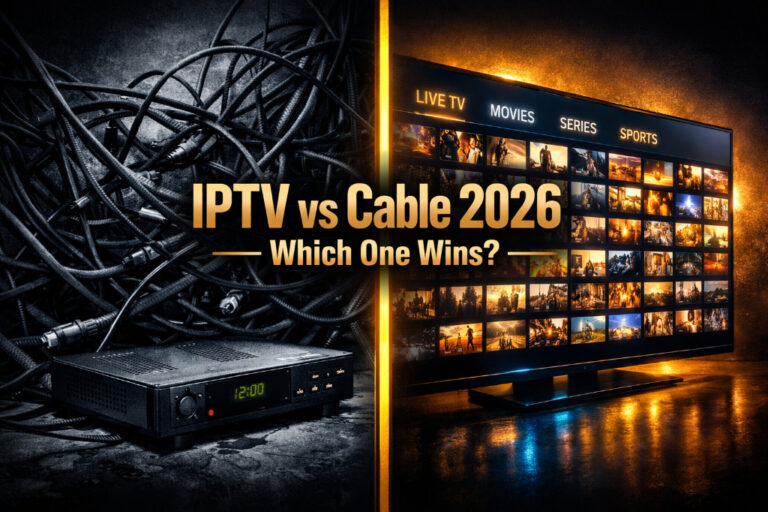
IPTV vs cable 2026 is the comparison every household making a streaming decision needs to see laid out honestly before committing to either option. Cable television has been the default choice for home entertainment for decades, backed by billions in infrastructure investment and the comfort of familiarity. IPTV has been quietly dismantling every argument for keeping cable for the past three years and in 2026 the case for staying with cable has never been weaker.
This is not a guide designed to bash cable unfairly or oversell IPTV with cherry-picked statistics. The goal is a direct, category-by-category comparison using real numbers and real performance data so you can make the most informed decision possible for your household and your budget.
By the time you finish reading, the winner will be obvious. But we will let the comparison make that case rather than declaring it upfront.
In the IPTV vs cable 2026 comparison, IPTV wins on price, channel count, device flexibility, contract freedom, and global content access. Cable wins on installation simplicity for non-technical users and local channel reliability in some markets. For the vast majority of households in 2026, a premium IPTV subscription delivers a significantly better overall value proposition than any cable package at any price tier currently available.
Table of Contents
IPTV vs Cable 2026: The Price Comparison
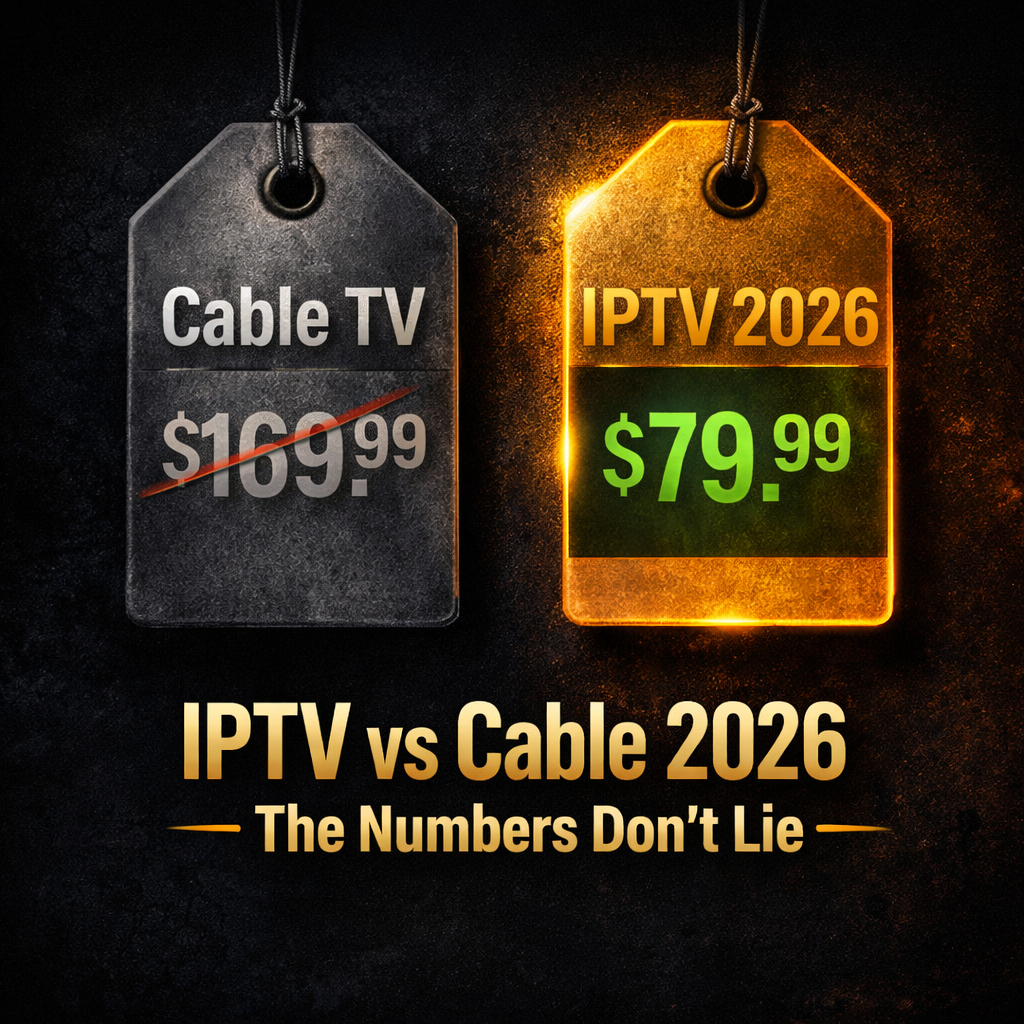
Price is where the IPTV vs cable 2026 comparison becomes immediately impossible for cable to win. The average American cable television bill in 2026 sits between $100 and $180 per month depending on the package tier and whether sports or premium channels are included. British Sky packages with sports run between £60 and £100 per month. These numbers have increased every single year for the past decade without a single year of reduction.
A premium IPTV subscription from a top provider in 2026 costs between $10 and $12 per month on a rolling monthly basis. On an annual plan the effective monthly cost drops to between $5 and $6. There is no equipment rental fee, no installation charge, no contract termination penalty, and no annual price increase built into the billing structure.
The monthly saving for a household switching from a mid-tier cable package to a premium IPTV subscription is between $90 and $160 per month depending on their current cable spend. Over twelve months that saving compounds to between $1,080 and $1,920 per year. These are not marginal differences. They represent a fundamental restructuring of what a household pays for television entertainment.
Cable companies have responded to cord-cutting pressure in 2026 not by lowering prices but by bundling internet service with television packages to make cancellation feel more complicated than it is. Separating internet from television billing and switching the TV component to IPTV is almost always financially straightforward, and the saving on the television portion more than compensates for any minimal reduction in bundle discount.
The price comparison in IPTV vs cable 2026 has one clear winner and it is not cable.
IPTV vs Cable 2026: Channel Count and Content
Cable packages in 2026 offer between 150 and 500 channels depending on the tier you pay for. Research consistently shows that the average household watches between 8 and 15 channels regularly regardless of how many channels their package includes. Cable companies know this and structure their packages so that the channels you actually want are locked behind the most expensive tiers.
A premium IPTV subscription in 2026 delivers between 10,000 and 16,000 channels covering every genre, every major sports league, every international market, and a VOD library that typically exceeds 50,000 titles. The channel count comparison is not close, but the more meaningful comparison is depth and quality within the categories that matter to your household.
Sports coverage is where cable has historically held its strongest argument. Regional sports networks, local team broadcasts, and exclusive league deals have kept sports fans tethered to cable packages they resent paying for. In 2026, the best IPTV providers carry every major sports channel including regional sports networks, meaning the sports argument for cable has weakened significantly compared to even three years ago.
International content is a category where IPTV wins unconditionally. Cable packages in the United States and United Kingdom carry a small selection of international channels as an expensive add-on package. A premium IPTV subscription includes channels from every major international market as a standard feature at no additional cost, making it incomparably better for multicultural households and expats wanting home country content.
VOD depth is another IPTV advantage that the cable comparison cannot overcome. Cable on-demand libraries are curated, limited, and frequently charge additional fees for new release movies. IPTV VOD libraries include recent releases, full series collections, classic cinema, and international content without additional per-title charges on top of the subscription fee.
IPTV vs Cable 2026: Picture Quality
Cable television in 2026 delivers HD content through a compressed signal that has to share bandwidth with every other subscriber on the same local cable segment. During peak evening hours when the entire neighbourhood is watching simultaneously, cable signal quality degrades measurably because the available bandwidth is divided among more concurrent users than the infrastructure was originally designed to handle.
IPTV stream quality in 2026 is determined by the provider’s server infrastructure and your own internet connection rather than by shared local cable bandwidth. A quality IPTV provider with properly scaled server capacity delivers consistent HD and 4K stream quality regardless of how many other subscribers are watching simultaneously, because server scaling is a software and hardware investment that the best providers make as a core business priority.
4K HDR content is where the quality comparison becomes most stark. Cable companies in 2026 offer a limited selection of 4K content at heavily compressed bitrates designed to fit within broadcast bandwidth constraints. The effective visual quality of cable 4K is noticeably inferior to genuine 4K IPTV streams from top providers, which deliver significantly higher bitrates without the compression artifacts visible on large screens above 55 inches.
For households with 4K televisions who want to see the full capability of their hardware, the picture quality argument in IPTV vs cable 2026 favours IPTV decisively at the premium end of both markets.
IPTV vs Cable 2026: Device Flexibility
Cable television in 2026 requires a set-top box or cable card for each television in your home that you want to receive cable channels. Each additional box typically costs between $8 and $15 per month in rental fees, and the boxes themselves are physically tied to the room they are installed in. Watching cable on your phone or tablet requires a separate app login that is often restricted by the cable provider to a limited number of devices or tied to your home WiFi network.
A single IPTV subscription in 2026 works on every device you own simultaneously up to the connection limit of your plan. Your television, your phone, your tablet, your laptop, a Firestick in a bedroom, and another device in a kitchen can all access the same subscription concurrently. There is no additional hardware to rent, no room-by-room installation, and no restriction on which network the device connects through.
The practical implication for a family household is significant. Children watching cartoons in their room, a parent watching sport in the living room, and another parent watching a series on a tablet can all use the same IPTV subscription simultaneously without conflict, without additional cost, and without any device being tied to a specific physical location in the house.
Travel flexibility adds another dimension to the device comparison. Cable television stops at your front door. A quality IPTV subscription travels with you to every hotel room, holiday apartment, and international destination you visit, delivering the same channel library on any device with an internet connection regardless of your physical location anywhere in the world.
For a complete guide to setting up IPTV across every device in your household, this walkthrough of the best IPTV player apps in 2026 covers installation and activation on every major platform so your entire household can be set up within an hour of subscribing.
IPTV vs Cable 2026: Contracts and Commitment
Cable television contracts in 2026 remain a genuine source of frustration for millions of subscribers. Standard cable contracts run for 12 to 24 months with early termination fees that can reach $200 or more depending on how far into the contract term you cancel. Price lock guarantees that cable companies advertise at signup frequently expire after the first 12 months, leaving subscribers paying more than they originally agreed to for the remainder of a contract they cannot leave without penalty.
IPTV subscriptions in 2026 carry no long-term contracts at any reputable provider. Monthly plans cancel at the end of any billing cycle with no penalty and no notice requirement. Annual plans represent a 12-month commitment in exchange for the deep discount they deliver, but they do not carry termination fees in the way cable contracts do. If your annual IPTV subscription underperforms, the worst outcome is not renewing at the end of the year rather than paying a penalty to leave early.
Price stability is another contractual advantage that IPTV holds over cable in 2026. The monthly rate you pay for a quality IPTV subscription is the rate you continue paying at renewal. There are no promotional rate expiries that trigger automatic price increases, no equipment fee hikes timed to coincide with contract renewals, and no administrative fee additions that appear on your bill without corresponding service improvements.
IPTV vs Cable 2026: Setup and Reliability
This is the one category where cable holds a genuine advantage over IPTV for a specific segment of users. Cable television installation is handled entirely by the provider’s technician, requires no configuration from the subscriber, and continues working independently of the household’s internet connection quality or speed.
For subscribers with limited technical confidence, the zero-configuration nature of cable installation removes a barrier that IPTV setup, while genuinely simple in 2026, still presents to some users. Installing TiviMate on a Firestick and entering Xtream Codes credentials takes under ten minutes for most people, but for subscribers with no prior experience of sideloading apps or managing streaming device settings, that ten minutes can feel intimidating without guidance.
IPTV reliability in 2026 depends on two factors that cable reliability does not: your internet connection quality and your provider’s server infrastructure. A household with a reliable 50 Mbps or above internet connection and a top-tier IPTV provider will experience reliability that matches or exceeds their local cable service. A household with a marginal internet connection or a budget provider will experience more instability than cable during peak hours.
The setup advantage that cable holds is real but diminishing. IPTV providers in 2026 have invested significantly in simplified onboarding guides, video tutorials, and live support specifically designed to walk non-technical subscribers through installation without difficulty. For anyone who finds the setup process unclear, this complete guide to fixing IPTV buffering and setup issues resolves the most common first-time setup problems in plain language.
Full IPTV vs Cable 2026 Comparison
| Category | IPTV 2026 | Cable TV 2026 | Winner |
|---|---|---|---|
| Monthly Price | $10 to $12 | $100 to $180 | IPTV |
| Channel Count | 10,000 to 16,000 | 150 to 500 | IPTV |
| 4K Quality | Native 4K HDR | Compressed 4K | IPTV |
| Device Flexibility | All devices anywhere | Set-top box only | IPTV |
| Contract | No contract | 12 to 24 months | IPTV |
| International Content | Included standard | Expensive add-on | IPTV |
| Setup Simplicity | 10 minutes self-install | Technician install | Cable |
| Travel Access | Works worldwide | Home only | IPTV |
| VOD Library | 50,000 plus titles | Limited, pay per title | IPTV |
Frequently Asked Questions
Is IPTV better than cable TV in 2026?
In almost every measurable category, IPTV is better than cable TV in 2026. It costs between 85% and 92% less per month, delivers ten to thirty times more channels, works on every device anywhere in the world, requires no contract, and offers 4K HDR quality that exceeds what cable delivers at any price tier. Cable retains a marginal advantage only in installation simplicity for non-technical users.
How much can I save by switching from cable to IPTV in 2026?
The average household switching from a mid-tier cable package to a premium IPTV subscription saves between $90 and $160 per month. Over a full year that represents a saving of between $1,080 and $1,920 depending on your current cable spend. Annual IPTV plan pricing pushes those savings even higher by reducing the effective monthly IPTV cost to between $5 and $6.
Does IPTV have the same channels as cable in 2026?
IPTV has significantly more channels than cable in 2026. A premium IPTV subscription delivers between 10,000 and 16,000 channels compared to the 150 to 500 channels in a standard cable package. The specific channels available depend on the provider, but the best IPTV services carry every major cable network, sports channel, and premium entertainment channel alongside thousands of international options.
Is IPTV reliable enough to replace cable in 2026?
Yes, IPTV is reliable enough to fully replace cable in 2026 for any household with a stable internet connection above 25 Mbps. Top providers maintain 99.9% uptime across their server infrastructure, which translates to less than 9 hours of downtime per year. Cable service outages, by comparison, affect entire neighbourhoods simultaneously and can last significantly longer when local infrastructure fails.
What do I need to switch from cable to IPTV in 2026?
To switch from cable to IPTV you need a stable internet connection of at least 10 Mbps for HD streaming, a compatible device such as a Firestick, Smart TV, or Android box that you likely already own, a free IPTV player app such as TiviMate, and an IPTV subscription from a quality provider. The entire switch takes under 30 minutes and can be completed the same day you decide to cancel your cable contract.
IPTV vs Cable 2026: The Verdict Is Clear
The IPTV vs cable 2026 comparison produces a clear winner across every category that matters to the vast majority of households. Price, channel count, picture quality, device flexibility, contract freedom, international content, and VOD depth all favour IPTV by significant margins. Cable retains a narrow advantage only in installation simplicity, a gap that shrinks every year as IPTV setup becomes faster and more guided.
The question in 2026 is no longer whether IPTV is good enough to replace cable. It clearly is. The only remaining question is how long you are willing to keep paying a cable bill that costs ten times more for a fraction of the content, on a fraction of the devices, locked to a fraction of the locations where you actually want to watch television. Test IPTV free for 24 hours today and make the switch with complete confidence.